Showing posts with label Gear. Show all posts

Tuesday, June 28, 2022

Non-Lethal Self Defense; When just a little bit of pain is enough

 During a recent preparedness presentation on 72 hour bags I gave to the IT dept. at my work one of the questions that popped up at the end was, "What about guns and firearms?" This was a loaded question (no pun intended) if I ever heard one considering today's environment, but I provided a sufficiently, politically correct answer in my opinion. Explaining that I am firearms enthusiast and a "2nd Amendment proponent", I also clarified that "guns are not for everybody", regardless of the opinions of some folks out there. I then recommended some less-than-lethal alternatives for affective self defense without the need to put a (preferred) 3" hole in an attackers chest. 

However, non-or-less-than-lethal measures come with a training and proficiency requirement which, in some ways, is just as important as training and proficiency with a firearm. It's a shock to many people when I advise that just buying pepper spray or a stun gun and tossing it in your purse or vehicle's glove box is not sufficient. You need to intimately familiarize yourself with these items for them to be truly affective in a self defense scenario. Below I'll break down some of the pros and cons of the more common less-than/non-lethal self defense implements and strategies.

Disclaimer: Before pursuing any of these options, check local laws and regulations to ensure you remain within legal bounds when purchasing or carrying these items.

Also, please note that I'm not addressing the "bringing a knife to a gun fight" concept here. It's assumed that there is a power discrepancy between attacker and victim in which the protective tools and strategies listed below provide an equalizer for the victim's defense.

Pepper Spray


How can personal chemical warfare not be fun for the whole family? Pepper spray is one of the most common and readily accessible non-lethal options of self defense out there. It's relatively inexpensive and easy to find, even at your local Wal-mart or typical sporting goods store. Pepper spray comes in a wide variety of options. These include disabling compounds such as (literally) chili pepper extracts, and deployment methods such as an aerosol spray or gel stream.

Pros

Pepper spray canisters are very compact and can easily be attached to keychains or staged in purses. They're very easy to use with a small locking lever that's easily shifted into active status, and a simple push-button and aim process. Potency can vary, and some self defense instructors recommend upgrading to actual bear spray for maximum effectiveness against burly human beings.
Many versions of pepper spray also contain a dye that's visible only in ultraviolet light. This allows for quick identification of the attacker by law enforcement during their investigation after an assault. 

Cons

Dispersal, especially the aerosol kind, can be hazardous. Discharging pepper spray into the wind can easily blow back into the face of the victim rendering both them and the attacker helpless to the point it becomes a race to see who recovers faster and either escapes or continues the assault. 
Less expensive pepper sprays can be less affective and not adequately stop an attacker.

Stun Guns and Tasers

A good friend of mine was considering buying a stun gun for his petite, real-estate broker wife while we were at a prepper show one time. The vendor offered him 10% off if he but-briefly shocked himself with the gun. My friend (I'll call him "Larry"), who's an adventurous as well as frugal sort, started seriously considering it, pacing back and forth and asking me what I thought. Now I'm too old for such nonsense myself, so I tossed my hands up with a grin and stepped out of the situation to go shop for freeze-dried food. A few minutes later from across the vendor hall my son and I heard the easily recognizable pop pop of the stun gun along with Larry's yell of surprise. It wasn't long after when Larry was walking up to us with a slight limp and a self-satisfied smile at having saved 10% off his purchase.
Stun guns and tasers both provide an electric current through the body of an attacker, rendering said-attacker temporarily disabled so the victim can make their escape. 

Pros

I've seen 280lbs ex-cons go down instantly after getting stunned in the buttocks. Their explanation later was that they'd never felt such pain. Tasers and stun guns are also readily available in most States. Tasers come in a variety of deployment configurations, from wand-like devices so you can feel like Harry Potter (yelling Expecto Patronum! just adds to the satisfaction of sending your attacker to the floor in a writhing, quivering ball of flesh), to gun-type devices which work just like a firearm in a point-and-shoot feel.

Cons

Stun guns deliver their charge on-contact meaning you have to be up close and personal with your attacker to deploy. If you're that close to your attacker you're already losing, in my opinion. 
Tasers, which deliver their charge through two projected prongs, can avoid this, but those prongs must make contact with the attacker's skin to be affective. Heavy clothing such as a parka or even a heavy hoodie, or a mis-fire where one prong doesn't make contact with the attacker, voids the counter attack completely.
I've also heard of attackers who are in an altered state (read: drugged out and trippin'), can be completely unaffected by either tase or stunning. I've seen video of this where a very high woman was tased by police officers no less than four times in a McDonalds where she'd gone on a French Fry rampage. The tasing offered little to no affect in stopping the meth'ed out Karen.

Batons, Baseball Bats, and Bludgeoning Implements

Beating the ever-living shit out of someone who'd been trying to attack you a few minutes prior can be pretty satisfactory, but doing so can be harder and more dangerous than most people consider. This class of self protection weaponry considers anything from a fancy stick to improvised items. 

Pros

There's almost no end to what can be improvised into a self-defense bludgeoning weapon. I've seen modified pipe wrenches, legs of broken tables, and souvenir baseball bats and everything in between. Extendable batons are easily concealed on one's person or in a vehicle, and come in a variety of size options to suit the defender's needs. It's also hard to not look totally cool flicking one of those baton's into action and taking a ready posture which may very well intimidate your way out of a confrontation. Of course this image is quickly ruined when you have to find a slab of concrete to bang the tip against to retract the baton afterwards.


Cons

Again, using a bludgeoning weapon to protect one's self means your attacker has already gotten dangerous close to you. You run the risk of the weapon being taken from you and used against you at that point. On that note using a baton or other bludgeoning implement, frankly, requires training to be affective. Wildly swinging to try to just keep someone away from you, again, runs the risk of having the weapon taken from you. Get trained! Most martial arts studios will help you with this (for a fee of course).
The expandable baton's are illegal in several states and municipalities so, again, check local laws and regulations before purchasing or training with one.

Martial Arts

Pros

As the saying goes, training trumps gear. The three types of weapons above to provide a physical advantage in a self-defense scenario, however they fail or be taken from you. Being able to affectively fight with your physical body grants you access to self defense at all times including those times when any other weapon is simply not allowed such as a court house or Federal building or such. Additonally most martial arts programs offer training with weapons as well, making you even more affective with the bludgeoning class of weapons above.

Cons

Being an affective martial artist is a non-stop endeavor. It requires constant practice and at least a modicum of physical agility and strength. It's very unrealistic, even dangerous, to take an 8 hour rape-prevention class and believe you're "ready" for if that time comes. I would argue that the choice to become a martial artist is more of a life-style commitment more than a brief practice.
Health issues and even age can seriously and quickly diminish one's ability to utilize martial arts as a self defense option as well.

Final Thoughts

There are other options regarding non/less-than lethal self defense but in my experience these are the most common, often times because they're the most affective. Training and familiarity of usage cannot be over emphasized. I've been known to buy two containers of pepper spray and discharge one to see how it's going to disperse. There many good videos on YouTube regarding using the different kinds of pepper spray and tasers. Watch, read, and learn and, in the end, you may opt for more than one or even all of these options. Diversity is a very good thing.

In the end walking around city streets with an AR-15 strapped to your back or even a .45 on your hip isn't always practical or, to some, ethical, however this doesn't mean you have to be a victim by any means. There are many other extremely effective options to protect ones self, your family, and your preparations, and with just a little research and education the right choice can be made for your personal situation and goals.


Peace. 

Thursday, March 17, 2022

Levels of Preparedness Equipment - Part 1; Bags and Knives

Nearly every prepper I know has a budget in which to purchase their gear across all the categories of preparedness. From firearms to heirloom seeds to bunkers buried deep in the ground, those preparing for a disaster or disruptive event need to carefully spend hard-earned dollars to leverage their priorities. Whether you have a budget of $1,000 or $1,000,000, what you buy and how much you spend can define your level of preparedness over all. Spending $10 on a knife that breaks the first time you use it as opposed to spending $125 on a knife that lasts you 30 years can mean the difference between life and death in a survival situation, but that has to be balanced with what you can afford. I've always said there's a fine line of benefit between having cheap gear and having no gear at all. A $10 knife that breaks after cutting a cord at least cut the cord before it failed, for instance. 

Over time most prepper budget's grow and with greater funding comes the ability to afford better quality gear. Also, with the ability for online selling, such as on Facebook Marketplace, Ebay and others, we preppers can engage in virtual swap meets, selling our older gear and buying better stuff cheaper either new or as 'gently used'. With that in mind let's break down levels of new, store-bought prep gear based on what you can afford. 

For this installment we'll start with the most expensive components of your 72-hour kit - Bags and Knives. We'll cover home and vehicle prep kits in later segments. I may also delve into other gear such as water filtration systems and first aid kits later down the road. 

Disclaimer: I am not getting any 'kick back' for listing these items, and this post is in no way meant to be an endorsement of any company or product. The pricing I list for any individual item is as of the writing of this post, and sale prices are tagged with '(s)'. This list is also meant to be a 'basic' break down regarding bags and knives, and will not cover all aspects of either. It is meant to be a reference for those starting a preparation plan and 72-hour bag or those seeking to improve their existing plan or kit.

Bags


The actual bag packed for bugging out or evacuation is critical. At the lowest tier a bag must meet the following criteria.
  1. Size; to accommodate three days worth of supplies and gear, a bag should not be smaller than 50 liters, and preferably 60 liters or even larger depending on the physical stature and athletic capability of the person hauling it.
  2. Material; a bag should be made of a solid composition, such as a heavy nylon or milspec canvas in quality. The bag should be resilient enough to track through heavy brush and woodland or grind along brick and mortar buildings in an urban environment without tearing and spilling your supplies all over the ground.
  3. Appearance; having a solid tactical, military-looking bag is all badass and such, but can draw unnecessary attention. It just screams, "Hey look, that guy has stuff," and can give the impression that you're a(n active) member of the military. I strongly sway towards a hiker's backpack that will call less attention to you.
Not only is your bag arguably the most important component of your 72 hour kit, it can likely be the most expensive. Pricing varies widely based on material and layout.
  • Inexpensive: Walmart.com, Aibecy Hiking pack - $56.49.
  • Mid-cost: Dicks Sporting Goods, High Sierra Pathway - $109.99
  • Expensive: REI, Osprey Traverse - $229.00
  • Richy-rich: REI, Osprey Aether Plus - $350.00

Other Considerations

Aside from the three required criteria above, backpacks come with a host of options to be considered, such as fit, weight distribution, expandability, and load-out configuration. When shopping for a bug-out bag with my fiancé, we went to REI to check out their selection. One thing I really like about REI is you can test the gear. They have weighted sacks you can use to simulate gear and load up your chosen backpack then you can try it on and see how it fits on your physical frame. I picked two packs within our budget and my fiancé snagged the cheapest one and headed to the checkout. I told her she needed to load it up with the weights and try it on to which she replied with a shrug, "Why, it's a backpack. They're all the same", but she headed to the table to load them up and try them anyway. I stepped away to shop for survival food and when I came back she had the other pack in her hand. "Yeah, this one feels a lot better with stuff in it" she admitted. Trying out a backpack and having a plan on how you want to load it can help with the decision on where those precious dollars go, too.

Knives

Having a good quality knife on hand cannot be over stated. Still, some of the best knives I've had throughout my life have cost me less than $50. One of those funny "psychological ironys" I've seen and experienced is spending $100 or more on a knife and not using it because "You don't want to mar it or mess it up," but the cheap $25 knife that you don't care as much about is the one you drop in your EDC and becomes your favorite because you use it every day.

In this section I'll break down knives and offer tiers for folder and fixed-blade options. For the fixed-blade options I required them to be full tang, but didn't go into other qualities (such as steel type, length, shape, etc) for the purpose of scope.


Other Considerations

Even more than backpacks, knives come with extensive options and features all focused around intention. Blade shape, composition, and length all vary, as can handle and over-all weight. Other options of a knife purchase might include a good sheath and even accessories, such as ferro rods, that may come packaged with the knife itself. Depending on your knife budget, spending just a few more dollars may offer a considerable upgrade.

Final Thoughts


Upgrading is the key to maintaining and improving a solid preparedness posture, and everyone who has a preparedness plan should always seek to better their position through improving their gear. Regarding the conflict between the cheapest of gear and no gear at all, I believe in having at least the cheapest of gear. I'll work up from there.

Peace.

Wednesday, June 30, 2021

Preparedness Kits and Bags - A Few Examples

 Ask my fiancé and she'll confirm, I'm a sucker for a good bag. Tactically designed with lots of pockets and expandability and I'm throwing my money at the cash register. In the preparedness community there are several types of bags, and kits most 'preppers" herald to suit a variety of purposes. In this post I hope to cover and clarify a few of those kits along with their intended purposes from convenience to surviving disasters.


The EDC Bag

EDC = Every Day Carry for those of you not familiar with the parlance. For most of us our EDC kits consist of what we can stuff in our pockets or on our belts (hence why I swear by cargo pants/shorts), but for a few that's not always enough. A small bag for the over-fill is either necessary or comforting to these folks. EDC bags tend to be smaller in size, maybe only a liter or two, and contain knives, a fire making kit,...even a firearm and ammunition, etc... . In my particular life situations, an EDC bag is overboard, but, again, for others it's a suitable solution.

The Day, or Hiking, Pack

A few steps bigger than an EDC bag, a day bag is designed for outings where more resources, such as food or snacks, may be needed. This is the bag I use for hiking. Not only do I drop a bit more food and water in there, but I'll also have a first aid kit, a fire building kit, a heftier knife, rain poncho, and some paracord. The volume of these items will depend on where we're hiking for that day and the weather. Hotter means more water. Farther will mean more food. The other items are "just in case" necessities that would allow me to live off the land should the hike go really bad or we get lost, etc... 

The Vehicle Bag(s) 

I warred with this one for a while. I've seen countless writeups on car kits and most articles seem to trip over whether the bag is designed for automotive repair or survival of the occupants. My solution? Two bags - one for each purpose. 

Vehicle Repair Kit


This bag contains items needed for quick-fixes and maintenance for your car. Items should include (among other things) reflective triangles, flares, a shovel (for snow and dirt), a can of Fix-a-Flat, etc.... I also have a wrench and socket set that includes screw drivers and a hammer and other tools. These types of kits can be found even in local retailers so it's not necessary to build one of these from the ground up, in my humble opinion.

The Car Survival Bag

This one tailors to you and your occupants in the event of an emergency. Extra food, water, a candle and coffee can (warmth and light), first aid kit, a change of seasonal clothes, etc... should all be included in this bag. The contents may rival that of a 72 hour bag and some people into preparedness refer to this particular bag as a Get Home Bag since the contents may have to be robust enough to get you through a hike back to home or at least to safety once other options are exhausted or it becomes too dangerous to stay with the vehicle at some point.

The 72-Hour bag (or...Bug Out Bag (or....BOB))

Everybody into prepping and preparedness knows this one. The bugout bag contains enough food, water, shelter, medical supplies, etc.... for it's pack mule (i.e. you) to survive for 72 hours, on or off grid. The bag should be kept at the ready at home, it's contents checked at least once every six months, and should be employed when it's no longer safe to stay at your home. This the bag that, when it's no longer safe to shelter-in-place, you grab and go with the intention that you will return to your house at some point once the danger is past.


The INCH bag (or the I'm Never Coming Home bag)

I've seen this idea tossed around a bit, but I've not quite been able to wrap my head all the way around it. Supposedly the INCH bag is a BOB on steroids. If you know you're not returning to your place of residence, this is the bag you grab. Sustainability is key, here. Space you would take up with dehydrated meals may now be taken up with equipment for making snares or performing a field dressing on a hunted kill. A smaller hydration pack may be used to make way for a larger water purification system within the pack. The bag itself would be a minimum of 70 liters or larger, and may be an external frame design for long treks. The bag and the load-out would be identical to a through-hike backpacker setting to trail over the course of two months or more.

Final Thoughts

There are endless types of bags and configurations in between these general examples I've listed, but over all this set of bags should cover most catastrophic disruptions (and minor convenience needs) depending on where you are and what you're doing. The first thing to consider when looking at these types of bags, should you decide you want to expand your bag collection, is the intention of the bag and contents, 100%. Once you have the intention, pick the right-size and type of bag, then start stocking the bag from there. As with a 72-hour bag, I think it's critical to regularly review all your bags, their content, and make replacements, restock, or improvements as needed.


Peace.

Wednesday, June 9, 2021

BattlBox Mission 76 Review

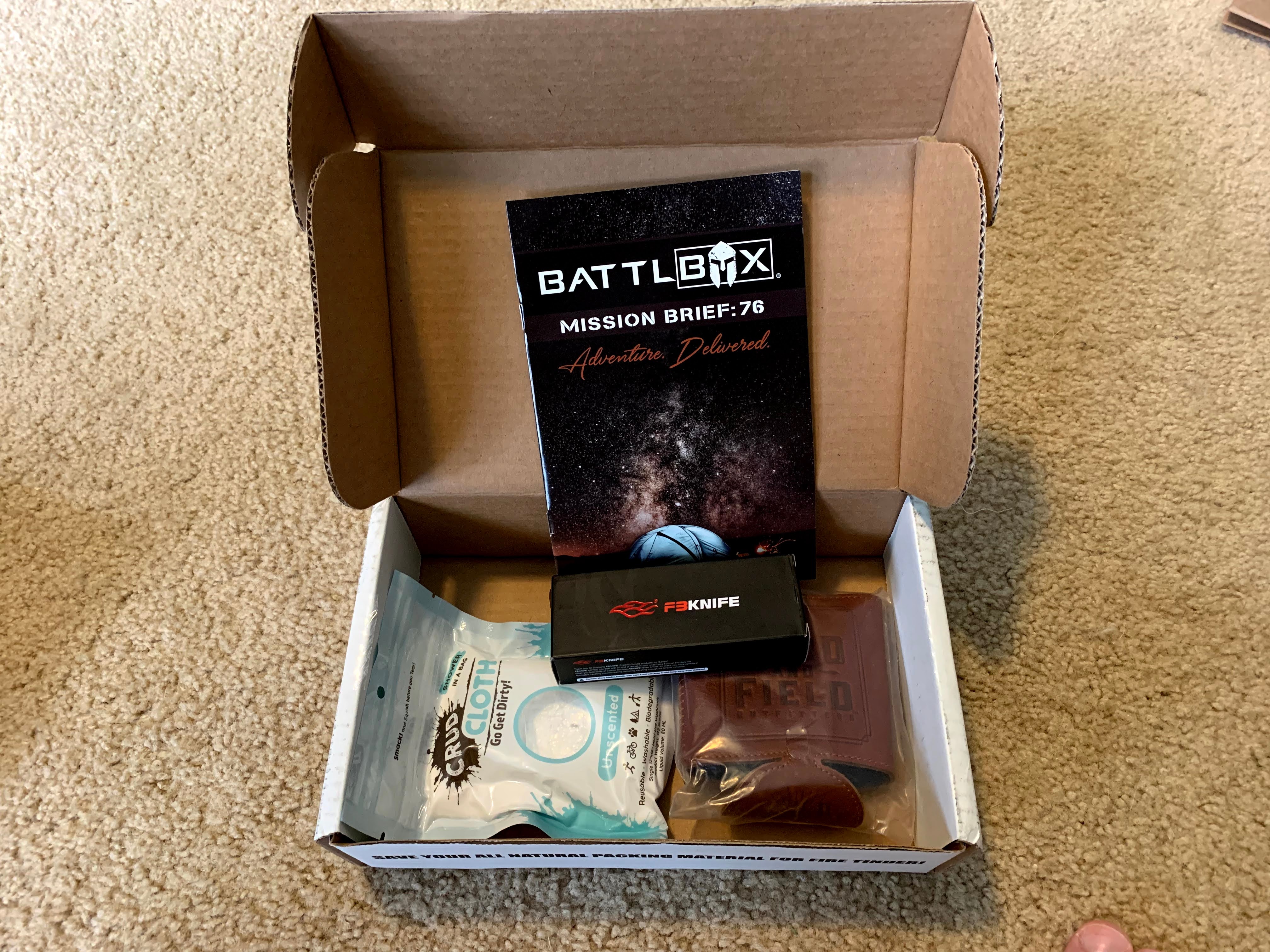
 Okay, so I gotta be honest, I was going to cancel my BattlBox subscription after my last review, but I let that lapse and I ended up getting another one. Below is my review of Mission Brief 76, Basic edition.


Stuff

Three items came in the box this month; a crud-cloth ("Shower in a bag"), a leather cozy by Lord and Field Outfitters, and a knife from Ganzo tools. Now, I'm a sucker for a good knife, almost as much as I am a good backpack or field bag, so the knife gave me pause. As usual, it's not like I need another knife, but hey, I've already paid for it so...yea!

Crud Cloth

MSRP: $4
  • Pros: 
    • Few beginner preppers worry themselves about hygiene when getting started in preparedness so a nice little compact way to clean and sanitize yourself and your gear is pretty clever. Toss this in any of your kits and you won't stink quite as much throughout the disruption. 
    • The 12"x12" washcloth in the package is washable and reusable so there's a dual purpose as a camp cloth, too.
  • Cons:
    • None that I can really think of other than there are options to get the Crud Cloth in other scents. The Crud Cloth that came in the box is unscented which is what I'd prefer in a disaster scenario if I'm washing my junk in the woods. The other scents (peppermint, tea tree, lavender, or citrus) may give you away or attract insects.

Lord and Field drink cozy

  • MSRP: $24.99 (remember, it's genuine leather).
  • Pros:
    • It's genuine leather and very well made. VERY well made.
    • It has the nice leather smell so when ever you take a drink of...whatever you're drinking, you get the bonus of a leather tinge.
  • Cons:
    • Despite being genuine leather, the price is violently high. If you're interested in this product, I suggest shopping around a bit.
    • I rarely use cozies and even if I did the need for one during a disruptive event escapes me.

The FBKnife by Ganzo Knives

  • MSRP: $26
  • Pros:
    • 440 steel
    • One-hand open operation w/lock (close is two-handed, then, obviously).
    • Built in belt/pocket clip.
    • Wicked-sharp out of the box (no, I didn't cut myself).
    • Over all the price is nice for the quality.
  • Cons:
    • It's made in China.
    • No sheath, just a little draw string sack to keep it pretty, I guess.


For the $41.73 I paid ($29.99 subscription + shipping + tax) I do question the value of the box. Bottom line is I could have taken that $41 and spent it on things I really needed (though it's questionable whether or not I needed another knife.)

Over all the products in this month's Basic box were, of course, good quality and, for the most part, usable. As with my first review, if you have the time and want to supplement your preparations, subscription services are fun, but for me, personally, I'm at the point I think the money's better spent in more precise ways.

Peace.

Wednesday, May 12, 2021

Freeze-Dried Food Review - ReadyHour

 ReadyHour freeze dried foods are bulk foods, meaning most packages of food contain serving sizes of at least 4. If you're feeding a family of four this is fine, but if you've less than that in your group you run the risk of some of the food going to waste. Most freeze dried meals don't provide left over storage options for later re-heating.

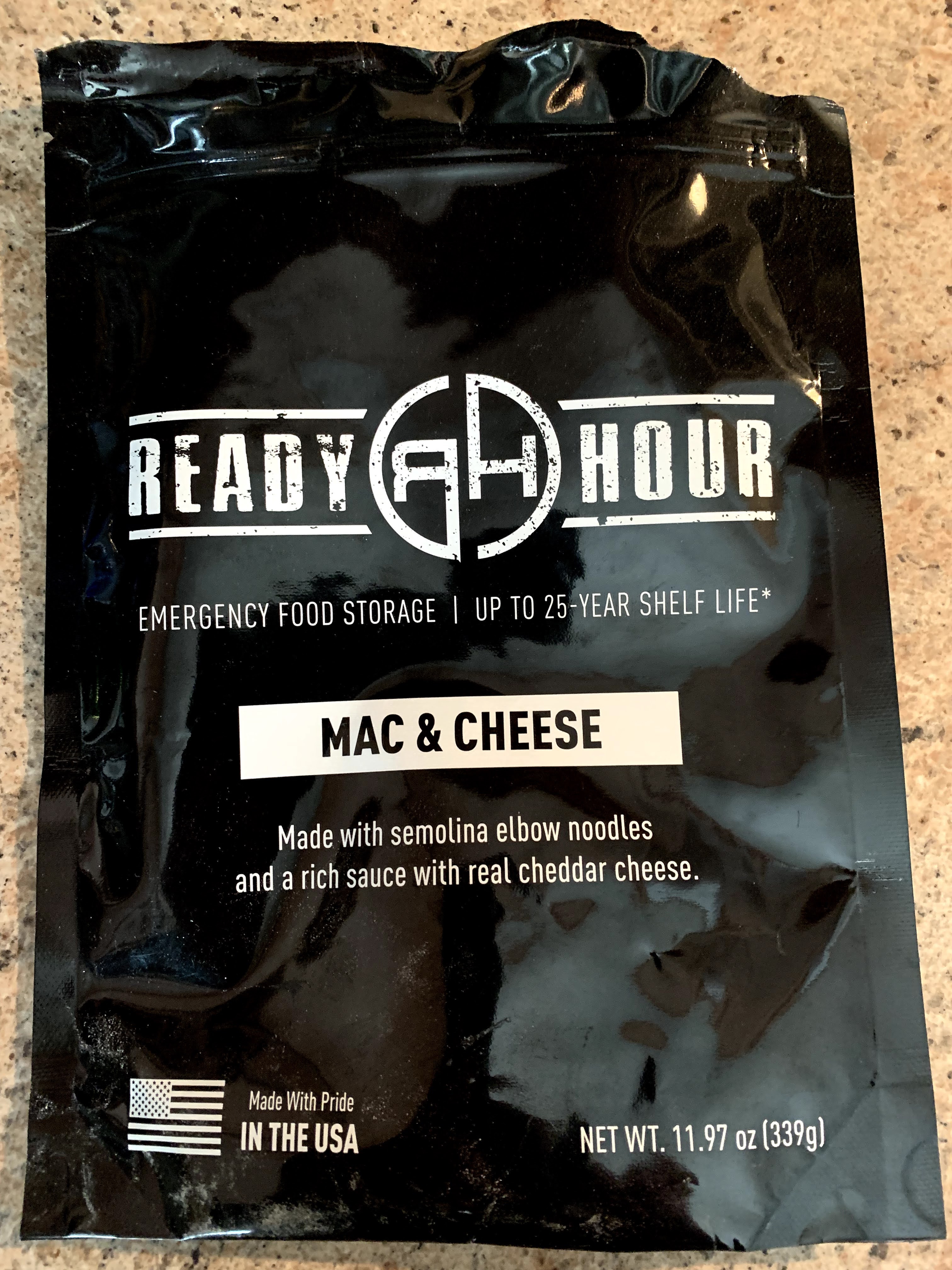
#1 - Mac and Cheese


Summed up in one word; blech!  I purchased the Ready Hour 72 emergency food pack which is what they consider to be their sampler pack (no free options offered). I cooked up this insufficient meal and gave it a go. Disclaimer: I followed the directions specifically. This particular meal differed from the others I'd sampled so far; you didn't pre-boil the water according to ReadyHour's instructions, and you use 4.5 cups to heat. You then boil the whole thing, cook for 15-20 minutes (mine cooked for 17 at a near boil), stirring all the while, then let sit 3 to 4. I did all of these religiously.


Specifics:

  • Price: $27.49 for the whole kit.
  • Serving size: 4 per bag
  • Calories: 310 per serving.

Cons:

  • Preparation; as indicated above the prep was different than most other dehydrated meals. I was wondering, while I cooked this, why didn't I just cook up a box of Kraft Mac & Cheese instead? In fact, aside from the claim that this meal will last in proper storage for 25 years, prep is really no different than Kraft or other store-bought Mac and Cheese.
  • Taste and Texture: I let this pot sit for 5 minutes and it was still cheese-flavored noodle soup. I added some shredded sharp cheddar cheese to assist with the consistency.
  • To me this is worth putting on this list again; store bought Mac & Cheese tastes better in addition to the preparation comment above.

Pros:

  • Shelf life: Yeah, if I had this in my storage and 12 years down the road it was between this and starving, I'm sure the box of Kraft would be long gone so ReadyHour Mac and Cheese it is.
  • Noodles: The noodles cooked up well, fluffy and didn't taste too bad.

Overall Rating: 3

---------------------------------

Monday, May 10, 2021

Freeze-Dried Food Review - ReadyWise (Formally Wise Food)

#2 - ReadyWise Cheesy Lazagna

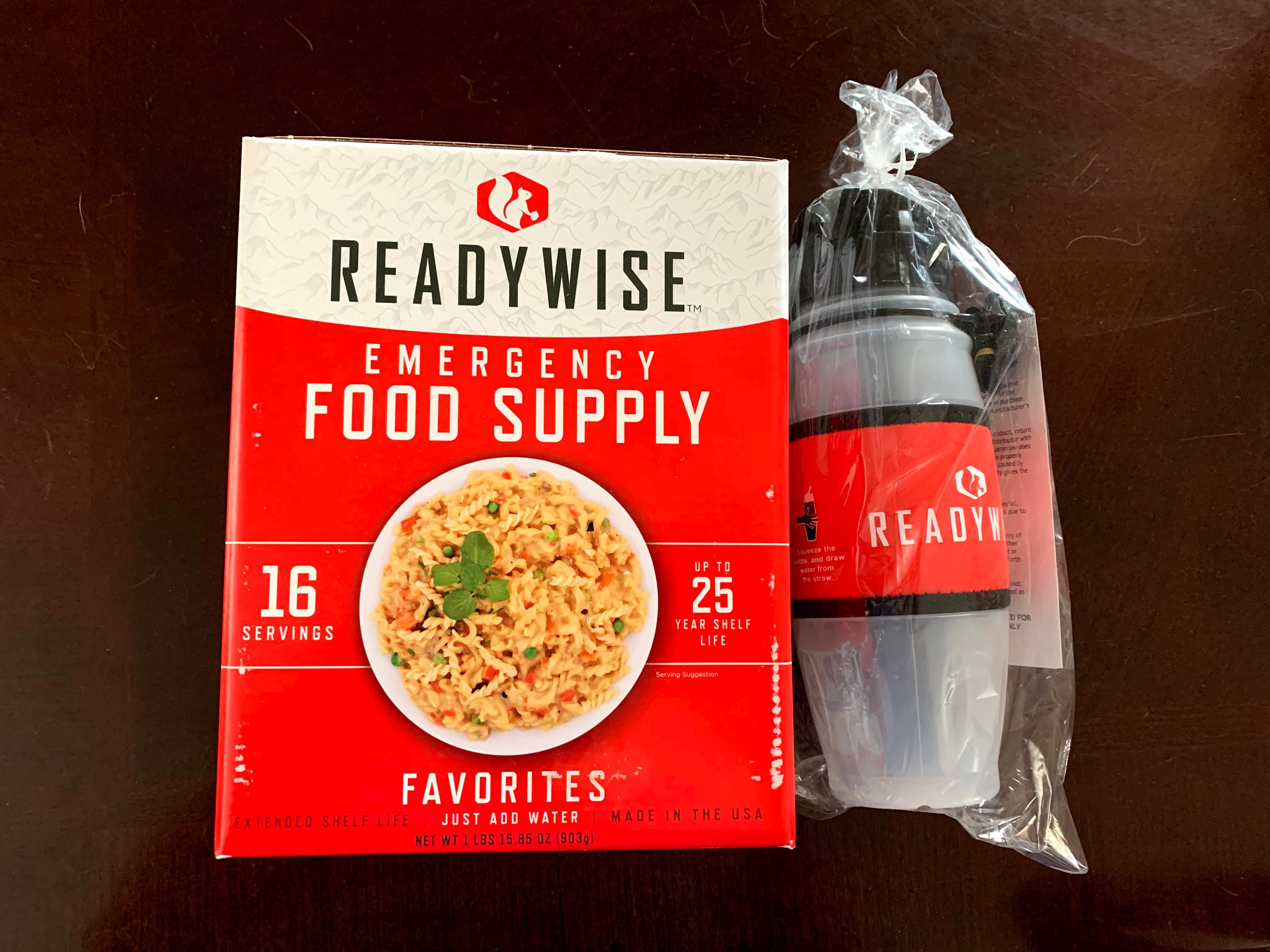
Sampled 5/11/2021; Pasta's pretty easy for a dehydrated meal. Most pasta-based freeze-dried meals boil down to the seasoning (pun intended). This pack came in the ReadyWise Emergency Food Supply box I got for just under $30 and it came with a water filtration bottle (SWAG!) This was just one out of four meals included in the box.
The Lasagna, like the others included, is a meal for four, so, again, if you're alone during the disruption and need to tap this particular food you may be throwing some out if you don't have the container and facilities to store the left overs.


The Specifics:

  • Price: $27.99 (online) for the box.
  • Serving size: 4 per bag.
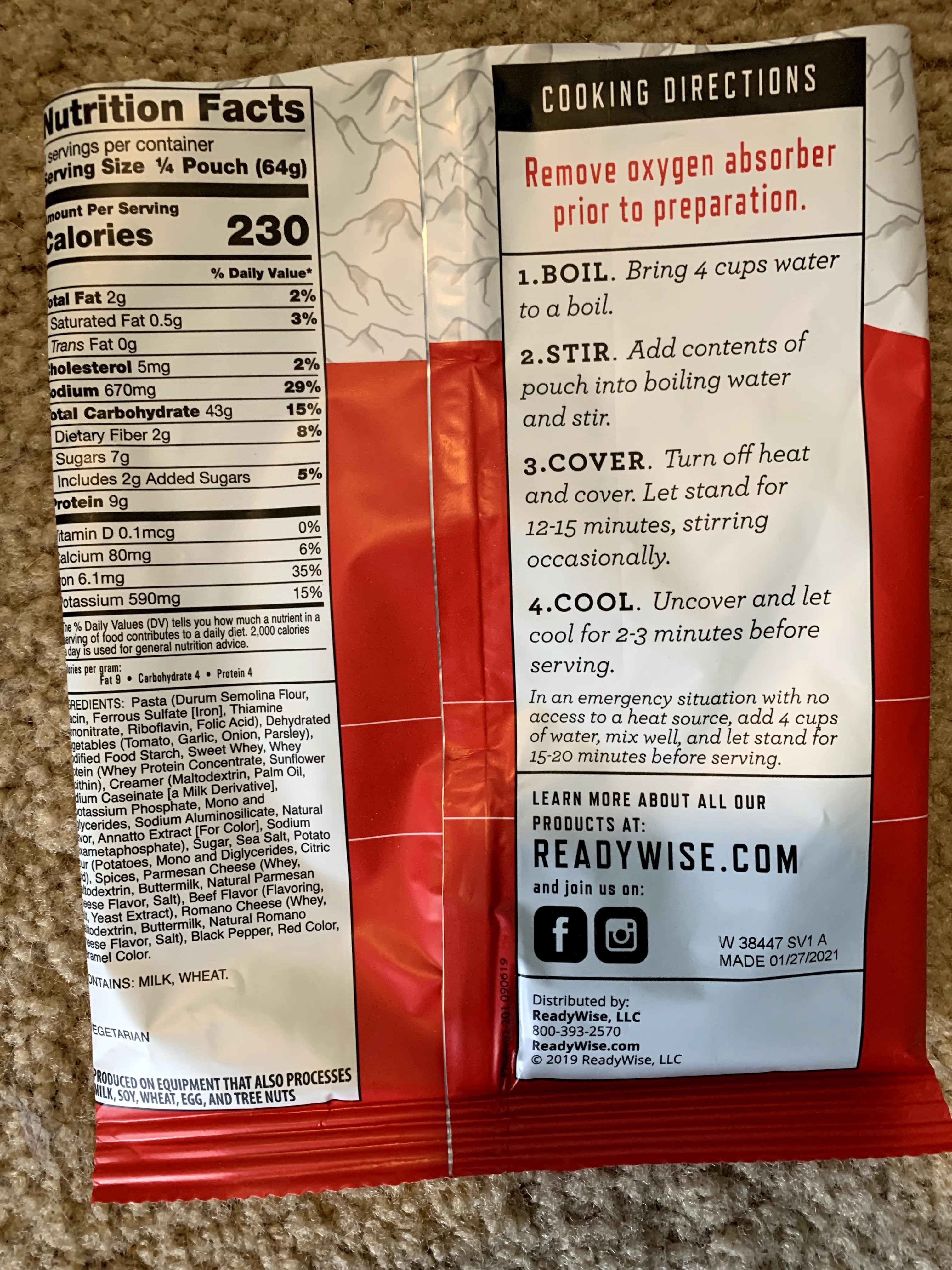
  • Calories: 230 per serving (920 for the bag).


Cons:

  • Again with the water! ...sort of. Four cups of boiling water were recommended. I cut that by about an eighth and it was still pretty soupy after 15 minutes. However, after I ate my first sampling and went back about 8 minutes later for more, the sauce had thickened up quite a bit. I think ReadyWise should probably increase the wait time from 12-15 minutes to a little longer.
  • Taste; when it got colder. The sauce was pretty salty and when the meal cooled down the tomatoey sauce sort of congealed a bit. This texture coupled with the colder consistency was a little on the gross side. As long as the lasagna stated hot it was still pretty good.
  • Some of the pasta noodles failed to hydrate all the way so there was a little crunch here and there as I ate, despite stirring and blending thoroughly during the prep process.

Pros

  • Taste; as long as it was hot the pasta was pretty well flavored. I was going to sprinkle some parmesan cheese on it, but there was enough cheesy flavor that it was unnecessary.

Bonus Points:

  • Swag: A water filtration bottle was included with the boxed kit.


Overall rating: 6

-----------------------------------------

#1 - ReadyWise Adventure Meal; Early Dawn Breakfast Skillet


Sampled 05/10/2021; I'm a sucker for breakfast foods in general so breakfast meals always catch my eye. This particular meal works best for camping or single-person use with only 2.5 servings and 470 calories for this volume in the bag. 

The specifics

  • Price: $5.99 (Dicks Sporting Goods)
  • Serving Size: 2.5 per container.
  • Calories: 190 per serving, approximately 470 for the whole bag.

Cons

  • Preparation: I can never seem to get the water right in these. ReadyWise instructs to use 2 cups of boiling water to hydrate, but even after the recommended 12-15 minute wait time the meal was still very soupy. I stirred again and waited another five minutes, but there was still a LOT of water left in the bag. This is not the first time I've had this issue. In fact I normally have to drain my meals of excess water before I start chowing down. Truthfully this is an issue with a lot of the dehydrated meals I've eaten, not just the ReadyWise brand.
  • The meal had peppers and onions in it which remained pretty rubbery even after 20+ minutes of sitting in the hot water.
  • The sausage pieces were few and far between. 

Pros

  • Value: I was relatively impressed with the price. When I snagged this particular meal, the comparable Mountain House meal was $2 more expensive.
  • Taste: the seasoning and the eggs were quite delicious. Even though the onions and peppers failed to hydrate very well, over all the meal was very edible and tasty. 

Bonus Points

  • Packaging: If you check the images closely enough you can see that ReadyWise dropped some jokes and Camping Hack information onto their packaging. This could serve as a happy little diversion for kids if you're making the meal during a grid-down situation. 


Overall Rating: 8

Thursday, April 22, 2021

Subscription Boxes - Thoughts and My First BattlBox

 I recently signed up for and received two subscription boxes from Battlbox.com, linked through a prepper podcast I've been enjoying, and I thought I'd share my thoughts and experience with the shipment. A lot of people into preparedness turn their noses up at subscription boxes and not for bad reasons at all. As I read on one preparedness forum I'm a member of, most people, "save the money you'd spend on random stuff and use it to buy stuff you actually need." Although I whole heartedly agree with this statement I'm not to the point of writing off subscription prepping boxes just yet.

Most subscription boxes such as these offer tiers of membership. Battlbox themselves offers four tiers; basic, advanced, pro, and pro+. Pricing ranges from $30 per month to $160 a month. There are additional boxes out there (some links at the bottom of this post), but a cursory search and I found TacPack, BespokePost, and Cairn subscription services.

**Please note that most of my assessment and comments have to do with Battlbox and these shipments altogether. Other subscription boxes may offer a different experience for a different value.**

What I got

When I signed up for the subscription I paid for the lowest level, Basic, and went ahead and splurged for the bonus box Battlbox offered. Both boxes came the same day and had the following content.

The Bonus Box


Four items came in the bonus box I received; 100' of paracord, a large camp towel from Grenade Soap, a Zippo Typhoon match kit (award for being the most useful/coolest), and a Colby Valve. Now, I had no idea what a Colby Valve is, but the packaging states it's, "...the only tool-free solution for replacing tire valve stems on-location in 5 minutes or less." This threw me for a serious loop. I've never had the need to replace a tire-valve stem, but I suppose if I had a bug out vehicle/golf-cart type of ride, this may come in handy at times.

The Standard Box


Again, four items (probably the standard), which included a cordage micro tool (used for shredding plastic bottles into cordage, apparently), four CamJam cord tighteners, a book; The Emergency Survival Manual by Outdoor Life, and a Buri drop point knife by Gear Aid. Fun fact! of the four items in this box, I already had two! The CamJams, which I'd bought from a local Tractor Supply and the book, which I'd picked up about a year ago at a local book store. I wasn't that upset about the CamJams; they're certainly something I can use more of (like firestarters), but the book indicated to me that I'd reached some level of peak saturation in one degree of my preps. Am I that addicted? (yeah, probably). Of course I don't blame Battlbox for these duplicates. They have no way of knowing what I have in my inventory.

Professed Value

One of the major pushes for subscription boxes is that you get more in gear value than what you actually paid for the box. I paid $30 for this month's subscription, for instance, and the knife alone is valued at that. The slight rub on this is the 'value' of the items indicated is tagged at the manufacturer's suggested retail price (MSRP) which, come on, everybody knows is over inflated already. Sheesh. Off the shelf at your local sporting goods store, that same knife would probably run you $25, and I saw a similar blade online for $10 off. The CamJams I'd bought were on sale for $5 to $7 dollars for the same four pack on clearance. The book has an MSRP of $29.99, though I paid less than $15 for it at my local book store. 

Dollar amount aside the quality of items in the boxes is overall high. From what I've seen and heard, specifically from Battlbox, this stuff's not junk. It tends to be mid-to-top quality gear. Add to that the fact that some of the items I may not typically find on my own, or even think about looking for. As an example, though I've not tested it yet, a small tool that can shred a plastic bottle into useful cordage is pretty slick.

Why Subscribe?

In general I can think of two good reasons to subscribe to a service like this.

You Can Afford It and Enjoy Monthly Intrigue.

This one may fall under the category of "wealthy prepper", but some folks may be able to chuck away the $30+ dollars a month for gear that's delivered right to their door. If you are already secure in your preparedness, have the financial resources to be a little frivolous, and enjoy a monthly "surprise", getting a subscription box may be or you. As you can see in the boxes I received I at least achieved the dollar value (MSRP, that is), I paid for in the box within one or two items. The rest was cheddar. 

You're Brand New to Preparedness and Aren't Sure Where to Start.

Over the course of weeks, months, or years, we people who are into preparedness accumulate quite a bit of gadgets and do-dads we can use to form sufficient kits and bags. I've gathered quite a bit of books and knowledge over time as well, but to someone brand spanking new to prepping it can seem overwhelming the amount of gear and raw knowledge needed to become sufficiently self reliant. A monthly box of gear can give you a good place to start, and kicks off that trend of gathering the right kind of gadgets and toys.

Looking at the two boxes I received in my first shipment, for instance, and we can see a new prepper would have a few essentials already; cordage, fire-starting capability, a decent knife, and a book to start a foundation of knowledge. Honestly, this is not too bad at all, and even aligns with Battlboxes claimed philosophy of providing materials and items useful in the Survival 13 key by Daniel Dabbs. To a brand new prepper, this is a great start and I commend Battlbox for being this thoughtful. 


Why or When Not to Subscribe?

Money is usually a factor when prepping and some of us simply don't have the funds to burn $30 a month on unknowns, especially if we have a dedicated plan where that $30 can be more precisely applied. Even for a newer prepper who has a detailed plan and who's still building up food stocks or other basics, that $30 can help towards those specific goals much more efficiently.

There is also the question of value. "IF" you had a crystal ball and could see what you're getting in the boxes before they come, it's assured you'd be able to save yourself a little cash shopping around for the same products cheaper. Add to that the fact that inevitably you're going to receive some items that simply aren't practical for your style of preparedness (I'm still not sure what I'm going to do with an emergency tire valve tool.) 

Final Thoughts

In the end subscription boxes boil down to how much money you have budgeted for preparations and what your tolerance is for acquiring 'stuff and gear'. If you're a little more experienced and/or know specifically what you want-per-dollar of your prepping budget, these boxes probably aren't for you.

On the other hand if you have the monthly budget to support the subscription cost and are looking to start or increase your preparedness and gear, a subscription box may be both enjoyable and beneficial. Again, my experience with Battlbox, so far, has been pleasant with good-quality gear and the 'surprise me' factor that my personality type is addicted to.

Lastly, these subscriptions aren't contractual, meaning you can literally cancel at any time. If you're still on the fence about whether or not you'd like a subscription box, sign up for a month or two and see how you feel about what you get. The benefit of cancelling any time makes the risk a lot less threatening.

Links

BattlBox (Coupon code; CASUALPREPPERS)
CAIRN (via Amazon)

*Disclaimer; I receive no promotional kick back for these subscription services. Links and review are only provided for the reader's information and entertainment.

Peace!